
What is a PV distributor?
A PV distributor can be very useful for a new solar panel installation or expansion of an existing solar panel installation. If you do not have any empty groups available in your fuse box (and do not want to install them) or it is not reasonably possible to install cabling from your inverter to the fuse box, a PV distributor can provide a solution. A PV distributor is actually a compact solar energy distribution box. PV is an abbreviation of Photo-Voltaic, where Photo stands for light and Voltaic stands for electricity. The PV distribution box is a compact meter box that divides an existing group, for example for a washing machine, into two groups. You can then use one group for the generated energy and the other group for energy consumption. A PV distributor is equipped with a main switch and a wall socket as standard. You can connect an appliance, such as a washing machine or dryer, to the socket of the PV distribution box.
Below you can see an example of how the PV distributor can be connected:

Why use a PV distributor?
An inverter with a capacity of up to 2.25 Amps may be connected directly to the mains via an existing wall socket. However, the capacity of the solar panel installation will usually be (much) higher, so the installation requires a separate final group. You can then opt to expand the installation cabinet, but this is not possible in all cases. In addition to expanding the distribution box, cabling must also be installed to the distribution box. If there are no empty pipes in an existing building, this often means drilling holes and having cables visible. By opting for a PV distributor, connecting the solar panel installation becomes a lot easier. You can use an existing group, for example from a shed, washing machine or dryer, and expand this group to two groups.
Advantages of a PV distributor
-
The installation cabinet does not need to be expanded
-
A PV distributor is relatively easy to apply in existing situations
-
A compact PV distributor can often be easily concealed in, for example, a laundry or storage room
-
Prevents the costs and work of installing cabling to the distribution box
-
A PV distributor is available for a relatively low price
Conditions for a PV distributor
-
It is recommended to have the installation of a PV distributor carried out by a certified installer.
-
The yield of the solar panel installation may not exceed 3680 Watts with a PV distributor. The PV distributor is protected with 16 Amps.
-
Only connect a PV distributor to a direct group, such as the washing machine.
-
The wire cross-section of the existing group must be at least 2.5 mm2.
Step-by-step plan for connecting a PV distributor
We recommend that you have an experienced installer connect a PV distributor. Below we will explain in a clear step-by-step plan how the PV distributor should be installed.
A handy checklist for a job that can be done well:
Preparation for connecting the PV distributor:
-
Loosen the screws so that the front plate of the PV distributor can be removed. Dismantle the connection block for the earthing (only necessary if this makes it impossible to mount it on the wall)
-
Mark the mounting holes on the wall (preferably close to a wall socket). The group to which the PV distributor is connected may not have any other users from the fuse box. Because a washing machine group is often a separate group, this is often a suitable group. After marking the mounting holes on the wall, the holes can be drilled in the wall and the plugs can be placed.
-
Clear 2 holes for the glands and secure the PV distributor to the wall. Has the connection block been removed? Then put it back in its place and then place 2 more glands.
Connecting PV distributor:
-
De-energize the group to which the PV distributor is connected. Tip: use a voltage detector to check whether the group is actually de-energized. Better safe than sorry!
-
Remove the existing socket, then it is time for the wiring.
-
Lay a cable (3x2.5mm² or 3x4mm², Neutral, earth and phase) from the PV distributor to the flush-mounted box.
-
Now connect the cable to the wiring of the flush-mounted box using welding clamps, bring the cable to the PV distributor and connect it to the main switch. The cable can be fed in via the gland that was previously installed.
-
Connect the earth wire (green-yellow) to the earthing terminal block. Connect the phase wire (brown) to the main switch on the left-hand side on the one marked 'L'. Connect the neutral wire (blue) to the main switch on the right-hand side of the main switch or to the zero position.
-
The cable coming from the inverter can be installed on a group. You do this by feeding the cable through a fitted gland. Then connect the earth (green-yellow) to the earthing terminal block. Then connect the phase wire (brown wire) to the earth leakage circuit breaker/installation circuit breaker (above) on the left side with the marking L. Then connect the neutral wire (blue) to the earth leakage circuit breaker/installation circuit breaker (above) on the right side of the phase wire or to position zero.
-
Now the green-yellow earth wire must be connected to the two earthing rails. Check that all wires are properly secured.
-
The group in question to which the distributor is connected can be turned on again in the fuse box. Then check that the installation circuit breakers remain switched on.

Finishing the PV distributor:
-
When you have completed all the steps and checks, the front plate can be placed on the PV distribution box. For safety, first disconnect the voltage from the group.
-
Make sure the recess for the glands has been removed from the front panel and then secure the front panel with the appropriate screws.
-
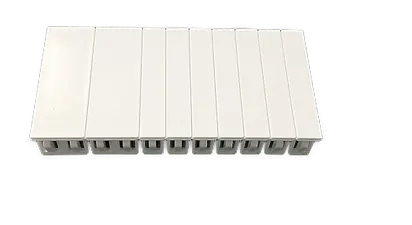
Any empty spaces can be filled with the spacers.
-
Now the power can be turned back on and the installation is ready for use.